
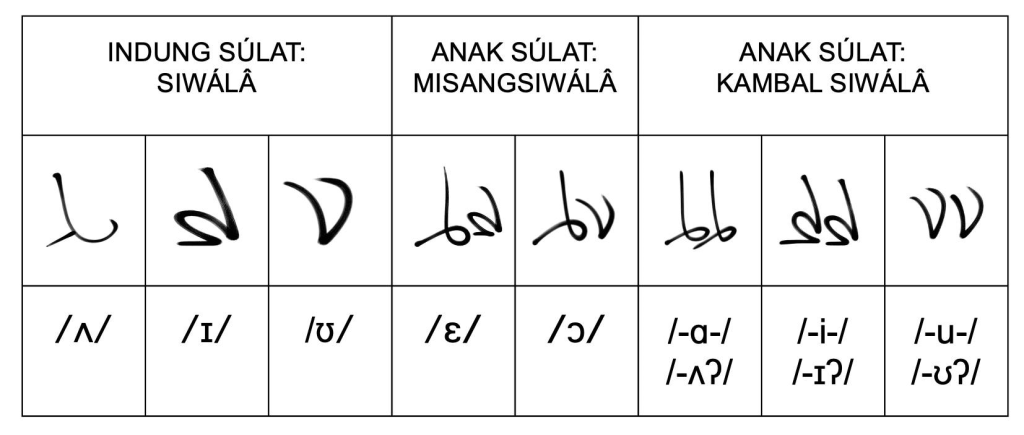
SIWÁLÂ ~ Kapampángan Vowels
Kapampángan has three basic vowels known as Indung Siwálâ ‘mother vowels’ that give birth two sets of Anak Siwálâ ‘offspring vowels’ ~ the monopthongized diphthongs known as Mísangsiwálâ and the long vowels known as Kambal Siwálâ.
The three basic Indung Siwálâ are /ʌ/ transcribed by the Spaniards as [a], /ɪ/ transcribed as [i], and /ʊ/ transcribed as [u].
Kapampángan /ʌ/, transcribed as [a], sounds more like the [u] in the English word “gun” than the Spanish [a] in “casa” and in Tagalog “bahay.” It is also similar to the [e] in the word “selamat] in Bahasa Indonesia than the [a] in “datang” in the same language. This has become the default sound in Kapampángan for the letter [a].
The [a] in the Kapampángan words “asan” and “mangan” are therefore pronounced as /ʌ/ ~ shorter and faster ~ than the Tagalog [a] in “bahay” and “bata.” This is the reason why Tagalogs are having hard time saying Kapampángan words because they have a different default sound for the letter [a] in their languages.
/ɪ/ like the [i] in the English word “fit” and /ʊ/ like the [u] in the English word “put” are pronounced short and fast.
The Kapampángan Language however makes a phonemic distinction between long and short vowels. These are currently indicated with the use of diacritical marks, as in this classic example by Mariano Henson: masakit (painful), másakit (sick), and masákit (difficult). [á] or the [a] marked with [‘] is lengthened, /-ɑ-/, when in medial position. It becomes a glottal stop when placed in the final position and marked with [ˆ]. The other Indung Siwálâ likewise become long vowels ~ “silab” (fire) is different from “sílab” (burned). “Búkû” (young coconut) is different from “bukû” (node, flower bud).
Kapampángans used to have dipthongs [ai]/[ay] and [au]/[aw] as evidenced by the early Kapampángan dictionaries and grammar books like those written by Bergaño in 1729 and 1732. Kapampángans therefore had words like Balay (house), Galau (move; work) and Balaybay (to thread along the edges). In the 19th century, the medial dipthongs were monopthongised while the final dipthongs were retained. It was only recently, perhaps in the late 19th century that every dipthong was monophthongized except for the Kapampángan dialect of Calaguiman in Samal, Bataan and the dialect of Mabatang in Abucay Bataan.
[ai]/[ay] in Kapampángan was monopthongized as /ɛ/, transcribed as [e], while [au]/[aw] was monopthongized as /ɔ/, transcribed as [o].
The sound of the letters [i] and [e] are therefore not interchangeable as some charlatans claim in their television interviews. Kapampángan “pálé” (rice), which used to be “pálai” can never be interchanged with “pálî” (heat). The same is true therefore with [u] and [o]. “Saklû,” ‘to fetch water from the river or well’ can never be interchanged with “sakló” which used to be “saklau.” It means ‘to conquer, to grab, to cover.’
How was the name of the Kapampángan town Macabébé written in the early Spanish records? Was it Macabaybay, its root being “baybay,” the edge of the river or sea? If so, when was the diphthong [ai]/[ay] changed to [e]? When did the town changed from Macabaybay to Macabébé? Was it ever written as Macabaybay or even Macabebay?